

A Shifting Global Policy Landscape
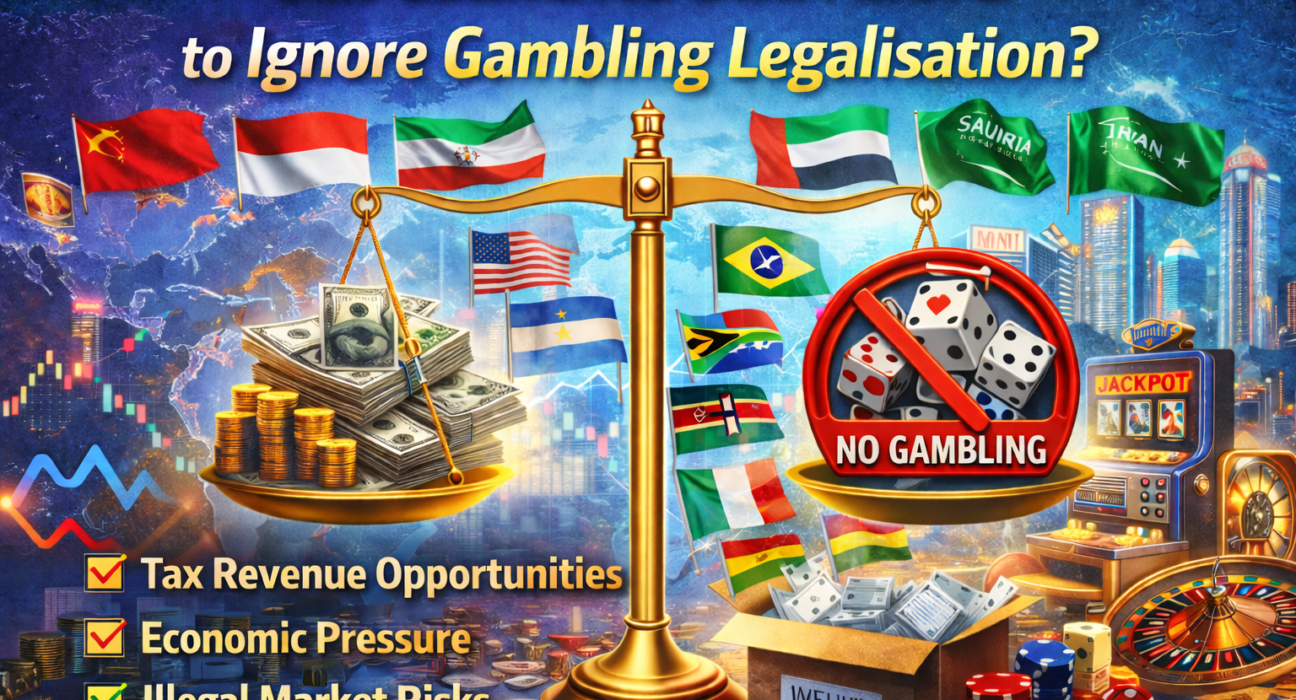
Across multiple regions, governments are revisiting long-standing positions on gambling regulation. What was once viewed primarily through a moral or cultural lens is increasingly being evaluated as an economic and fiscal policy question. Legalised gambling markets now represent substantial revenue channels, prompting policymakers to assess whether continued prohibition remains financially sustainable.
The shift does not imply universal acceptance, but it reflects a broader recognition that gambling already exists in most jurisdictions, either within regulated frameworks or through underground and offshore channels.
The Economic Case for Regulation
Regulated gambling markets generate billions annually through taxation, licensing fees, and associated economic activity. Governments benefit not only from direct gaming taxes but also from corporate income taxes, employment creation, tourism spending, and infrastructure investment tied to integrated resorts and betting ecosystems.
Where gambling remains illegal, these potential revenues often migrate to unregulated operators. This creates fiscal leakage: consumers still gamble, but the state captures little to no tax benefit. In contrast, legalisation allows authorities to convert an informal economy into a monitored and taxable sector.
The Cost of Prohibition
Maintaining a blanket ban on gambling carries both economic and enforcement costs. Illegal markets frequently thrive in restrictive environments, creating parallel economies that lack consumer protections, responsible gaming safeguards, and anti-money-laundering controls.
Governments must then allocate resources toward policing, litigation, and enforcement actions. Even with aggressive crackdowns, demand rarely disappears. Instead, activity shifts online or into informal venues, complicating regulatory oversight.
Cultural and Religious Resistance
Despite economic arguments, legalisation remains politically sensitive in many jurisdictions. Cultural norms, religious doctrine, and social concerns continue to shape national policy decisions. In several countries, gambling restrictions are deeply embedded in legal and ethical frameworks, making liberalisation a complex and gradual process.
Some governments pursue compromise models, such as limited casino zones, tourism-focused licences, or tightly controlled betting channels. These hybrid approaches attempt to balance economic opportunity with societal values.
Social Risks and Harm Mitigation
Opponents of expansion emphasise gambling-related harms, including addiction, financial distress, and public health implications. These concerns are legitimate and central to the legalisation debate. However, advocates argue that regulation, rather than prohibition, provides stronger tools for mitigation.
Modern regulatory frameworks typically include:
- Age verification and identity controls
- Responsible gaming mechanisms
- Advertising restrictions
- Self-exclusion systems
- AML and compliance monitoring
Without legal oversight, such protections are difficult to enforce.
Legalisation as a Governance Decision
Ultimately, gambling legalisation is not simply about revenue generation. It is a governance choice involving economic strategy, consumer protection, social responsibility, and regulatory capacity. Countries must evaluate whether prohibition effectively reduces harm or merely displaces activity into opaque markets.
As global gambling revenues continue to rise, the question facing many governments is becoming sharper: is it economically and structurally viable to remain outside a regulated gaming economy?
The answer varies by jurisdiction, but the debate is clearly intensifying.