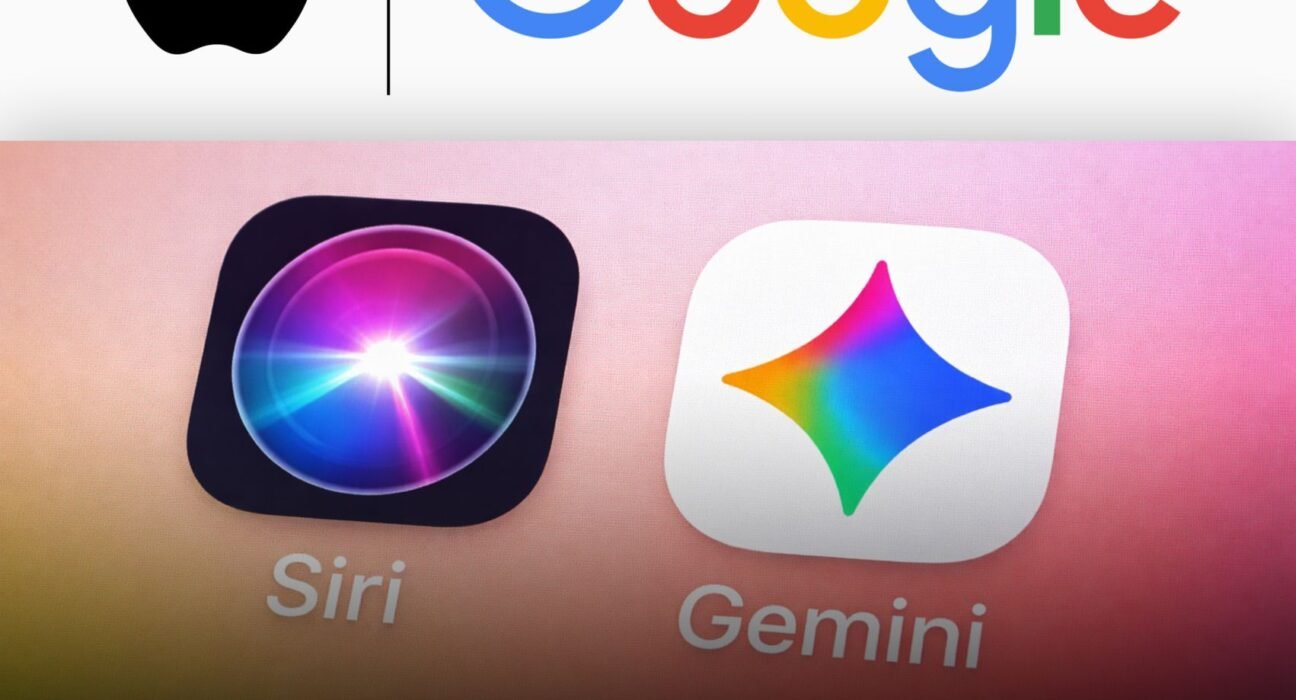


Google’s Gemini models will underpin Apple’s future AI capabilities, marking a strategic shift as Apple prioritizes performance, privacy, and user experience over building everything in-house.
Apple and Google have announced a major multi-year partnership that could reshape the competitive landscape of artificial intelligence. Under the agreement, Google’s Gemini models and cloud infrastructure will serve as the foundation for the next generation of Apple Foundation Models, which will in turn power upcoming Apple Intelligence features, including a significantly upgraded and more personalized version of Siri expected to roll out later this year.
According to Google, the collaboration will see Gemini integrated deeply into Apple’s AI stack, providing the core reasoning and generative capabilities behind Siri and other intelligent system features. Apple confirmed that it evaluated several leading model providers before selecting Gemini, concluding that Google’s technology currently offers the strongest combination of scale, performance, and maturity.
Despite relying on an external model, Apple emphasized that its long-standing commitment to privacy and security will remain intact. Apple Intelligence will continue to operate primarily on-device, supplemented by its Private Cloud Compute architecture for more demanding tasks. This means user data will still be processed under Apple’s strict privacy standards, with minimal data retention and end-to-end encryption, even when cloud resources are involved.
Strategically, the deal highlights a clear divergence in how the two tech giants are approaching the AI race. Google is positioning itself not only as a consumer-facing AI brand but also as a foundational infrastructure provider, embedding Gemini across third-party platforms and ecosystems. By becoming the underlying engine for Apple’s intelligence layer, Google significantly extends its influence and reinforces its role as a core supplier of advanced AI capabilities.
For Apple, the move reflects a pragmatic shift. Rather than delaying product innovation while racing to perfect a fully in-house large language model, the company is choosing to integrate the best available technology and concentrate on what it does best: seamless user experience, tight hardware-software integration, and trust. While the partnership may quietly acknowledge that Apple is currently behind its rivals in core model development, it also demonstrates strategic discipline and speed to market.
If the integration delivers on its promise, users could finally see Siri evolve into a genuinely capable, context-aware assistant, able to understand intent, perform complex tasks, and interact more naturally across Apple’s ecosystem. More broadly, the alliance underscores an emerging reality in the AI industry: leadership may increasingly belong not just to those who build the best models, but to those who successfully embed them at global scale.